From AI Legible to AI Actionable

Most organisations are AI Legible. They understand what AI can do. They have seen the analysis, named the opportunities, perhaps run some pilots. The gap between AI Legible and AI Actionable is where most AI investment dies. The board sees this gap as a delivery problem. The delivery lead knows it is a governance problem.

What AI Actionable means — precisely

Being AI Actionable is not an attitude or a cultural posture. It is a set of structural conditions.

Practitioners can act on AI initiatives without seeking approval for every decision. The boundary between what requires approval and what does not is defined and visible — not dependent on individual judgment or memory. Completion of AI-assisted work requires evidence, not assertion. The connection between a piece of operational work and the strategic commitment it serves is structural, not dependent on a champion keeping it alive.

Most organisations that commit to AI initiatives and then watch them stall had none of these conditions in place. The technology was not the problem. The governance architecture was.

The governance architecture problem

The default governance model in most organisations produces the familiar pattern: initiative committed, implementation stalls, initiative quietly deprioritised.

Too many decisions escalated upward. Boundaries poorly negotiated. Practitioners unable to move without approval. Applied to AI, this produces approval overhead at precisely the moments when pace matters most.

For the delivery lead, this is the recurring failure mode: an initiative the board considers committed, sitting in week 12 of a stall nobody can fix because the structural conditions for action were never put in place. The board does not see the stall — they see the slipping deadline. The delivery lead carries both.

Participative governance — the structural answer

The Realise stage embeds participative governance — the structural conditions under which practitioners can move on AI initiatives freely, within defined boundaries, without approval overhead.

The mechanism is an inversion of governance defaults: the default runs toward action, not permission. Boundaries are defined, visible, and enforced by the system — not by supervisors, not by memory. AI assistance is offered at precisely the points where governance is most demanding — alignment, criteria, completion verification — not as a route around governance, but as the mechanism that makes governance achievable without friction.

The governance is structural, not documentary. A constraint in a PDF does not prevent non-compliant behaviour; it records what non-compliant behaviour looked like. A constraint enforced at the point of creation — required by the system, not recommended by a policy — is governance as code: governance that works regardless of whether anyone remembers to consult the document.

Governance made visible
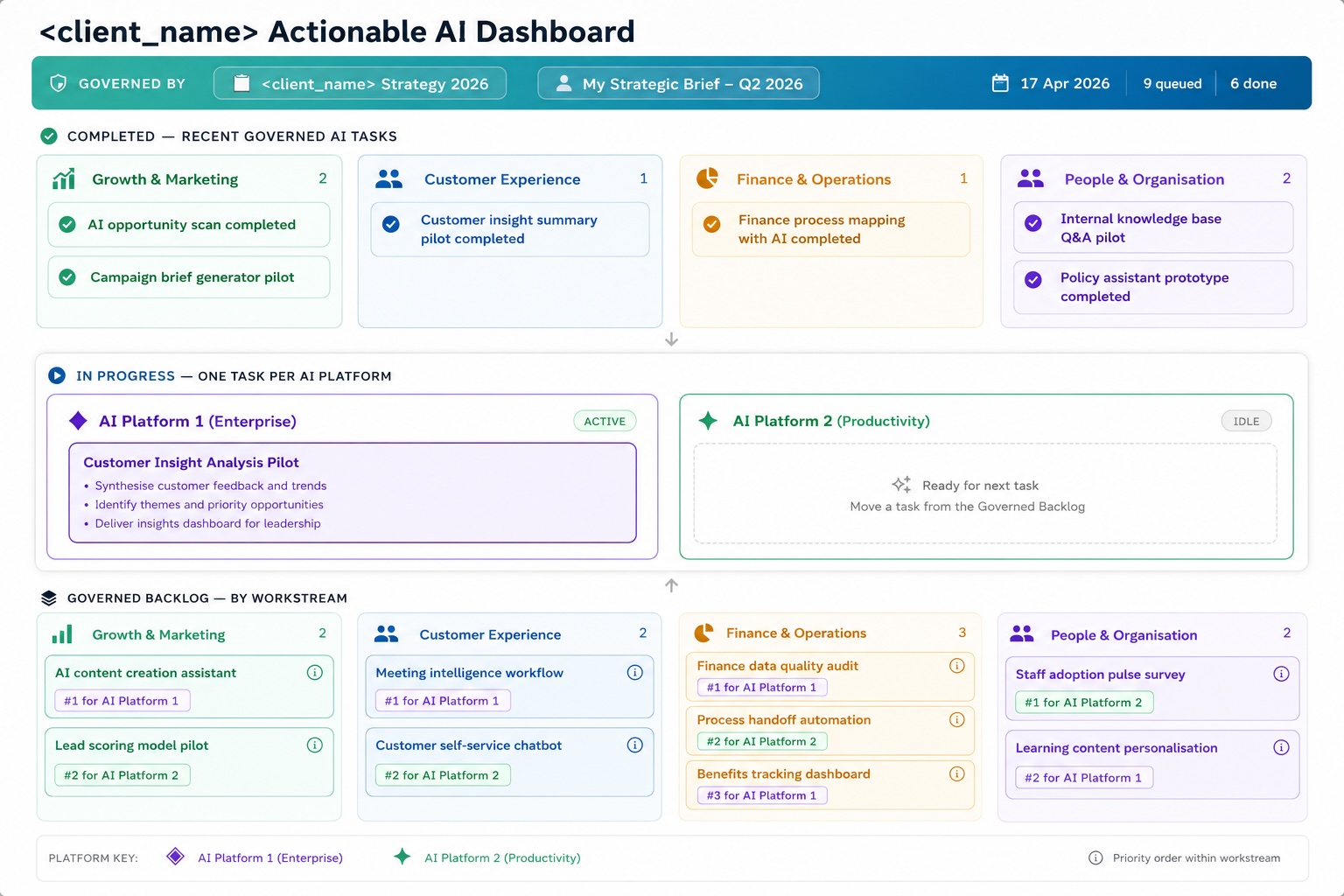
AI Value Worx governance dashboard
Task state visible — not in a status meeting
Evidence required at completion — enforced by the system, not suggested by a policy
AI-assisted where governance is most demanding
Workstream priorities enforced — not negotiated in a meeting

Governance enforced structurally: task state, evidence requirements, and AI-assisted completion in a single view. No PDF, no meeting, no memory required.

See how this becomes part of your organisation’s operating model →

The value realisation process
03
Realise
The AI Actionable gap
You are here

You’ve seen the three problems. Now see the evidence base that makes the solution credible — the AI Value Intelligence, running live.

See the evidence →
Get started →