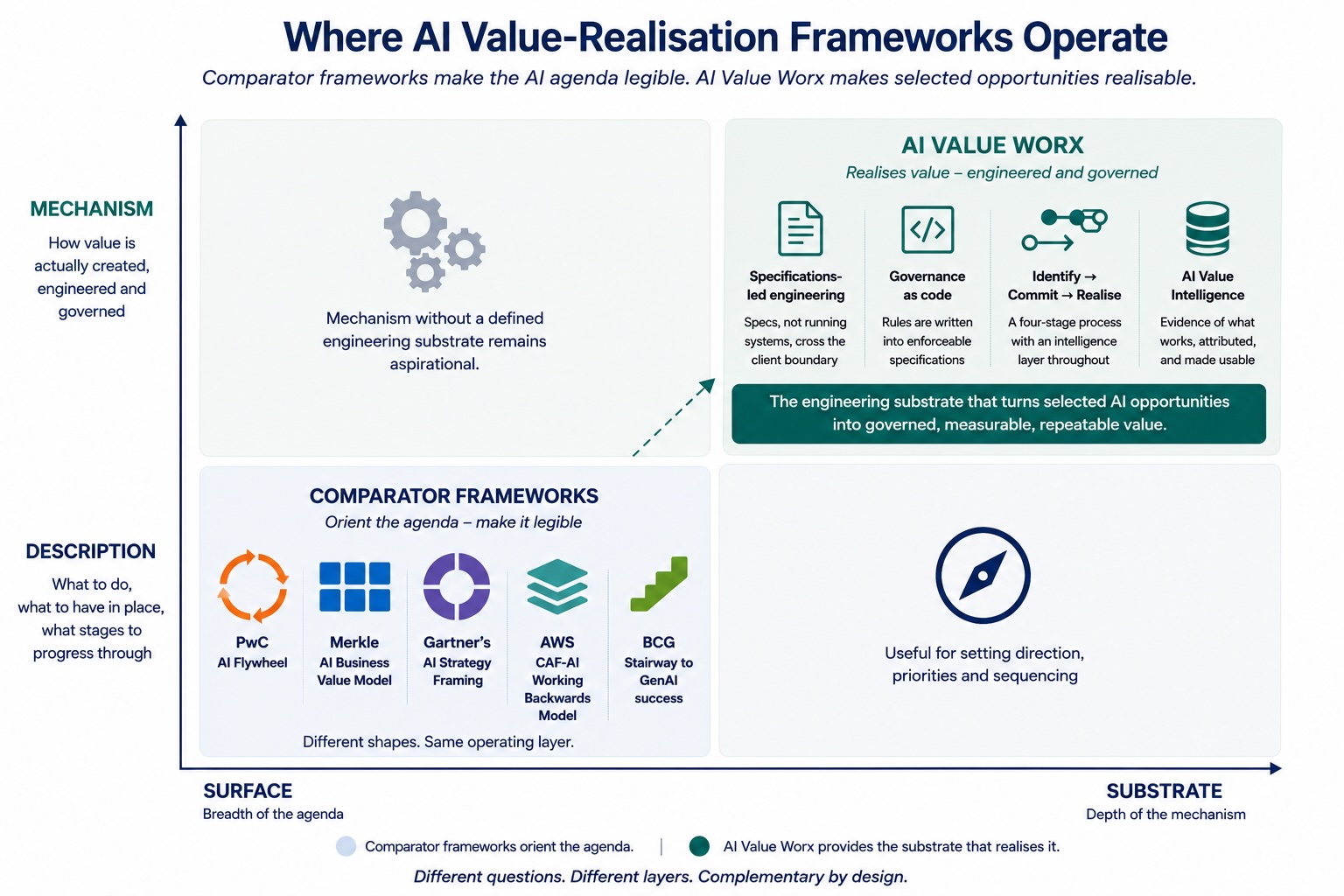
Anyone working seriously on AI strategy already has the major value-realisation frameworks as background mental furniture. PwC’s AI Flywheel, Merkle’s AI Business Value Model, Gartner’s AI strategy framing, AWS’s Cloud Adoption Framework for AI, BCG’s Stairway to GenAI Impact, these are the frameworks senior leaders cite in board papers, the diagrams that appear in transformation decks, the shapes that organise contemporary executive conversation about AI value. This article positions AI Value Worx against that field, treating each framework on its own merits, crediting what each does well, and explaining why AI Value Worx is doing different work: narrower in scope, deeper on mechanism.
A note on selection. These five are the major consultancy and hyperscaler frameworks that brand themselves as AI value-realisation or executive AI strategy at the portfolio level. The wider field is crowded, McKinsey Rewired, Deloitte’s GenAI scaling work, Microsoft and Google Cloud adoption frameworks, IBM’s AI Ladder, Forrester’s AI Value Matrix, MIT CISR’s enterprise AI maturity model, NIST AI RMF, ISO/IEC 42001, the EU AI Act, but the five chosen here are the comparators that share AI Value Worx’s frame of reference: organisations asking “how do we realise value from AI?” rather than “how do we manage AI risk?” or “how do we mature our data foundations?” That is the class this article addresses. NIST appears later as a deliberate exception.
The breadth pattern
What the five comparator frameworks have in common as a class is that each picks a shape, a flywheel, a building-block diagram, four pillars, a capability stack, a maturity stairway, and uses that shape to describe the surface of AI value-realisation work. They tell senior leaders what to do, what to have in place, what stages to progress through. PwC names a portfolio rhythm. Merkle names enabling architecture. Gartner names management domains. AWS names capabilities. BCG names maturity stages. Each shape makes the AI agenda legible.
That is real work. Making the agenda legible is what allows boards to govern, executives to commit, and programme leaders to sequence. Nothing in this article disputes the value of the orientation layer. The argument is that orientation is not realisation, and that orientation is not what most large organisations are short of in 2026.
What surface description doesn’t deliver
Naming the stages of a flywheel, listing the building blocks of an architecture, declaring four pillars of strategy, stacking capabilities, or charting a maturity progression, none of this, on its own, realises value. There is now substantial converging evidence for this from the major consultancies. McKinsey’s 2025 State of AI describes a market in which AI use is widening but scaled impact remains incomplete for most organisations, and notes that high performers differ from the rest by their use of management practices associated with value capture, senior-leadership ownership, human validation processes, adoption and scaling discipline. Deloitte’s 2025 State of Generative AI in the Enterprise frames the present moment as one of rising GenAI investment and continuing difficulty in proving ROI. Bain’s 2025 work goes further: GenAI does not create value through basic adoption, and ROI requires reimagining how work gets done and how a company competes.
Three independent consultancies, three converging diagnoses. The pattern they describe is not that organisations lack frameworks. They have plenty. The pattern is that the layer between describing what value realisation involves and the engineering substrate that produces it is missing. Surface description does not, by itself, supply that layer.
What depth on a mechanism looks like
The leading frameworks are valuable because they make the AI agenda legible. AI Value Worx is valuable because it makes selected AI opportunities realisable. That formulation captures the difference of orienting question. AI Value Worx does not try to map the entire surface of AI strategy. It picks the mechanism by which value is actually created, specifications-led engineering with embedded governance, and goes deep on that mechanism alone.
The mechanism has three architectural commitments. First, the firewall proposition: specifications, not running systems, cross the client boundary. The client’s own technical teams build inside the client’s infrastructure to module specs, governance-as-code specs, unit test suites, and data contracts produced during the engagement. AI Value Worx delivers the spec; the client delivers the system. Second, governance as code: the rules that determine how value is captured, protected, and evidenced are written into enforceable specifications rather than into separate policy documents nobody consults during build. Third, a methodology with three sequential stages, Identify, Commit, Realise, and an Intelligence layer running across them, where the AI Value Intelligence corpus provides claim-level evidence of what has actually worked, attributed to organisations, and made legible to AI systems and human practitioners alike.
This is a narrower argument than any of the comparator frameworks make. It is also, deliberately, deeper.
Where each comparator sits
PwC’s AI Flywheel
PwC’s flywheel is one of the most useful executive-level orientations on the market. It describes a cyclical operational rhythm, use cases, patterns, tooling, solutioning, cost and carbon, deployment and learning, adjacent scaling, anchored on a value hypothesis, with Responsible AI and Human-led approaches as cross-cutting commitments. It recognises that AI value does not come from a single implementation event but from iterative momentum. Its emphasis on value hypotheses is particularly strong because it anchors AI activity in expected business value rather than technological novelty.
What the flywheel does not address is the engineering substrate that turns a value hypothesis into a realised benefit. The flywheel describes the dance steps; the music, the specification discipline that synchronises engineering effort with strategic intent, is left implicit. AI Value Worx sits relative to PwC as the substrate that makes any flywheel actually turn. Where PwC names the value hypothesis as the orienting axis, AI Value Worx specifies how a value hypothesis becomes a governed delivery contract.
Merkle’s AI Business Value Model
Merkle’s model is comprehensive enabling architecture: eight building blocks (AI-Ready Training Data, AI Governance and Security, Business Case for AI, Conversational User Interface, AI Cost Structure and Environmental Impact, LLMs and AI Architecture, Users and Their Context, Finetuning and Master Prompts) plus two enablement loops covering Data and Technology and AI-Powered Customer Experience. Its strength is that it reminds organisations AI value depends on more than models. The customer-experience framing is particularly useful where AI is being deployed into customer journeys rather than internal productivity alone.
What Merkle’s model does not address is how the blocks are governed and specified once they are in place. A building-block model helps an organisation ask “do we have the necessary ingredients?” but does not answer “how are those ingredients governed into a working value-producing system?” AI Value Worx is the discipline that turns Merkle’s blocks from a checklist into an operating mechanism, specifying what each block must produce, how that production is governed, and how the blocks together evidence value.
Gartner’s AI strategy framing
Gartner’s public AI strategy work emphasises four executive concerns: vision, value, adoption, and risk. (The exact “4 Pillars” diagram appears in Gartner research notes that may sit behind the Gartner paywall; the underlying vocabulary, however, is consistent across Gartner’s public material.) The framing is clean and at exactly the right altitude for board and executive conversation. Vision, value, adoption, and risk are precisely the categories senior leaders need to avoid treating AI as either a purely technical agenda or a diffuse innovation theme.
What Gartner’s framing does not provide, and does not claim to provide, is a delivery mechanism. Pillars are management domains; they organise the questions executives must hold open. AI Value Worx is realisation depth where Gartner is strategic breadth. The relationship is complementary: Gartner helps boards ask the right top-level questions; AI Value Worx helps organisations convert the answers into governed delivery.
AWS’s Cloud Adoption Framework for AI
AWS CAF-AI is engineering-led capability scaffolding. It organises Foundational Capabilities (Business, People, Governance, Platform, Security, Operations) underneath an AI capability layer, then defines Transformation Domains (Technology, Process, Organization, Product) leading to Business Outcomes. The working-backwards discipline of starting from the outcome is genuinely valuable. CAF-AI is more pragmatic and implementation-oriented than purely conceptual strategy models.
What CAF-AI does not address is which capabilities to specify with what discipline as the stack grows. It frames everything as buildable capabilities; the question of what governance is embedded into each capability’s specification is left to the implementer. AI Value Worx adds specification governance where AWS provides capability scaffolding. The two are compatible: an organisation using CAF-AI to plan capability investment can use AI Value Worx to govern how each capability is specified, built, and evidenced.
BCG’s Stairway to GenAI Impact
BCG’s stairway is the most diagnostically honest of the comparators. It names four stages, Illusionist, Theorist, Showman, Money Maker, and pairs them with the powerful tagline that most organisations celebrate success too early. BCG recognises that demos, pilots, and visible activity do not equal economic impact, and that the transition from showmanship to P&L impact requires scale enablers, process redesign, people adoption, operating-model change, and execution to P&L.
What the stairway does not specify is the mechanism by which an organisation moves from one stage to the next. BCG describes the stages but not the engineering discipline that produces transitions. AI Value Worx is the route discipline: the mechanism for moving from a recognised opportunity to a specified, governed, engineered, and evidenced realisation. BCG names the destination; AI Value Worx specifies the route.
A note on NIST AI RMF
A sharp reader with NIST in mind may ask whether AI Value Worx is doing work NIST already does. The honest answer is no, but the boundary is worth naming. NIST AI RMF, with its Govern, Map, Measure, Manage functions, is itself a disciplined substrate framework, but it is risk-substrate, oriented around helping organisations identify and manage AI risks across the lifecycle. AI Value Worx is value-substrate: it draws from NIST and ISO/IEC 42001 as foundations for its embedded-governance commitments, but it answers a different orienting question. NIST asks how AI is governed safely; AI Value Worx asks how AI value is specified, governed, and realised. The two are complementary, and AI Value Worx cites NIST as foundation rather than competitor.
When to reach for each
Six frameworks, six questions, minimal overlap. Reach for PwC’s Flywheel when the organisation needs a shared operational rhythm across an AI initiative portfolio. Reach for Merkle when auditing whether the enabling architecture is in place. Reach for Gartner when framing AI strategy for the board. Reach for AWS CAF-AI when stacking capabilities in a cloud-native engineering organisation. Reach for BCG’s Stairway when calibrating maturity expectations and pushing back against premature success claims. Reach for AI Value Worx when the organisation has decided where to act and needs depth on the mechanism that converts the decision into realised value.
These are not six points on a single comparison axis. They answer different questions for different audiences at different moments in an AI programme’s life. The right deployment is plural rather than exclusive: an organisation may legitimately use Gartner’s framing in the boardroom, BCG’s stairway in maturity assessment, and AI Value Worx in the engagement that turns selected opportunities into shipped value.
A reading map for the rest of the AI Value Worx canon
This article is the orientation piece. The body of AI Value Worx doctrine lives in four spine articles, each taking depth on a different facet of the mechanism. The Complete Guide to Strategy Governance explains how the executive and participative governance distinction structures everything else. AI Governance from the Boardroom to the Front Line extends that distinction into the AI-specific case. Governance as Code sets out the six-layer architecture, Intent, Specification, Code, Enforcement, Validation, Audit, that turns governance from documentation into systems. Software by Specification makes the engineering case for why specifications, not running systems, are the right unit of value transfer.
Read them in that order if the question is “what is AI Value Worx?” Read this article first if the question is “where does AI Value Worx sit in the field of contemporary AI frameworks?” Both routes are legitimate; both end at the same place, the case for specifications-led engineering with embedded governance as the substrate beneath the surface of AI value-realisation work. For where that mechanism becomes an engagement you can commission, see aivalueworx.com.